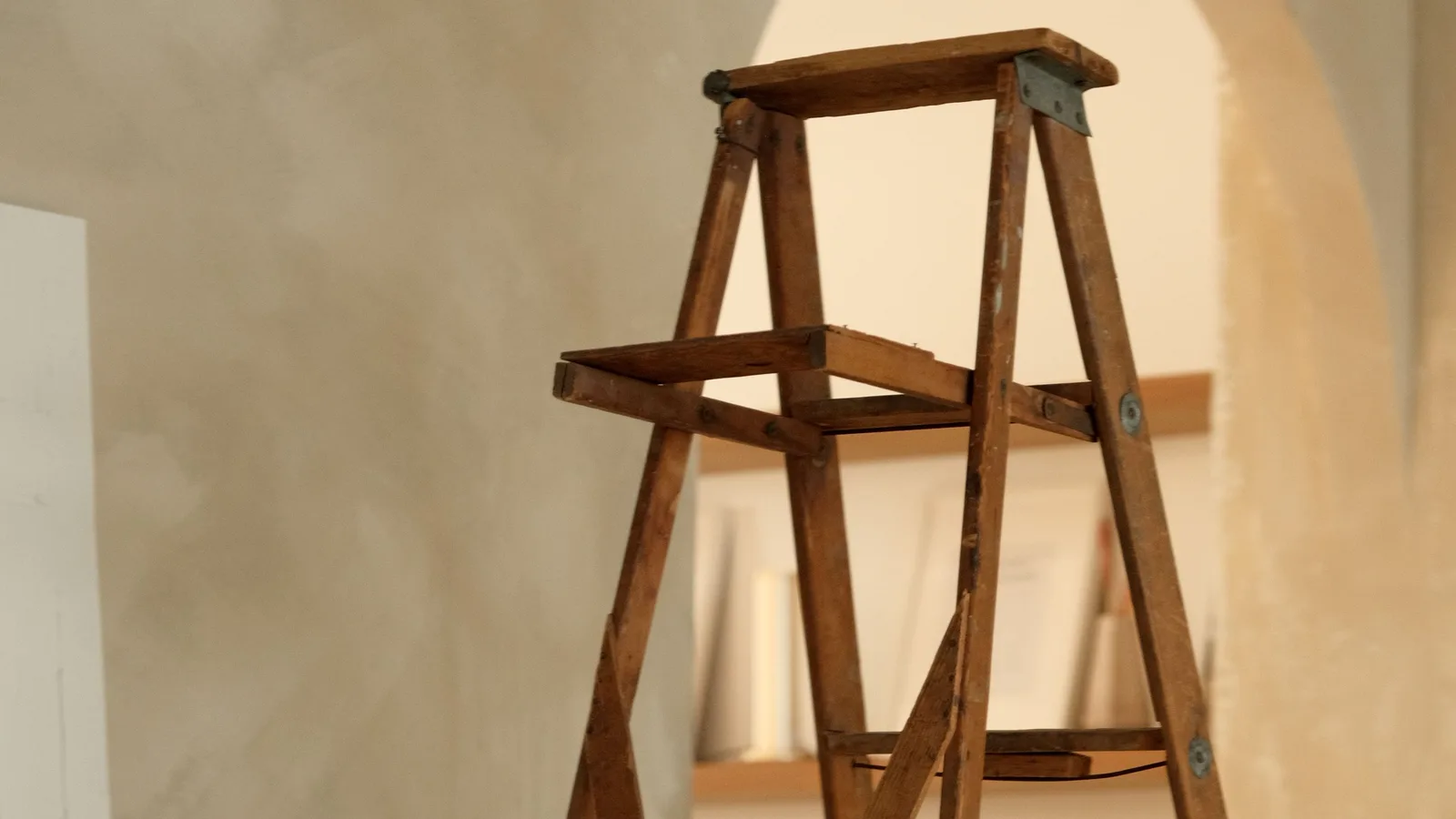
More and more of our painting calls start with a photo. Someone has seen a bedroom with soft, cloudy walls, or a bathroom that looks like it was carved from stone, and wants to know what it is and whether it can be done in their apartment. The answer is usually one of two finishes — limewash or Venetian plaster — and while they're often confused, they are very different things to live with. Here's how we explain it.
Limewash is the older and simpler of the two: slaked lime, water and natural pigment, brushed onto the wall in loose, crossing strokes. It doesn't sit on the surface like paint; it soaks in and reacts with the wall, which is why it has that soft, mottled, chalky look, lighter where the brush was dry and deeper where it was loaded. It dries matte with no sheen at all, and the color shifts with the light through the day. It's breathable, it's naturally resistant to mold, and it has no smell to speak of. On a good surface it goes on in two coats over a mineral primer, and a bedroom can be done in a couple of days including drying time.
Venetian plaster is a thicker material — lime putty with marble dust — applied with a steel trowel in two or three thin, overlapping layers, then burnished with the trowel until the surface tightens and takes on a polish. Done well, it looks like marble or honed stone, with depth you can see into and a sheen you can adjust from matte to mirror. It's hard, it's durable, and with a wax or sealer it stands up to a bathroom or a kitchen. It's also slower and more skilled work than limewash: the wall has to be perfectly flat first, each layer has to dry, and the burnishing is the part that separates a good plasterer from a bad one.
Which room? Limewash suits bedrooms, living rooms, dining rooms and hallways — anywhere you want softness and warmth, and anywhere the walls have some texture or age to them, because limewash makes a virtue of that. It's less happy in a bathroom that gets wet or a kitchen that gets greasy, because it's matte and porous and doesn't like being scrubbed. Venetian plaster suits feature walls, entry halls, powder rooms, fireplace surrounds and bathrooms — anywhere you want a focal point that reads as stone, and anywhere the wall needs to take a wipe.
What about the surface? Both need a sound, clean, primed wall, but Venetian plaster needs it flat: every bump and every roller stipple from the old paint shows through a polished finish, so we skim-coat or sand first. Limewash is forgiving of texture but not of the wrong primer — over ordinary latex it can flake, so it goes over a mineral primer that lets it bond. In a pre-war apartment with original plaster, both finishes look like they belong; on new drywall, both need that primer step and a little more care.
Cost, relative to paint: limewash is somewhat more than a good two-coat paint job, mostly for the primer and the extra drying time. Venetian plaster is considerably more — it's a craft finish, applied by hand in layers — which is why most people use it on one wall, a hallway or a bathroom rather than a whole apartment. Neither is a place to save money on the labor: the finish is the technique.
Living with them: limewash can be touched up with a brush and a little of the leftover wash, and it ages gracefully — small marks blend in. It shouldn't be scrubbed. Venetian plaster, once sealed, wipes clean with a damp cloth and lasts for decades; if it chips, a plasterer can repair the spot, but it's a repair, not a touch-up. Both are far easier to live with than their reputations suggest.
Still not sure? That's what the sample is for. We'll come to the apartment, look at the wall and the light, and brush a limewash sample or make a plaster board in the color you're thinking of, so you decide on the real thing rather than a photo. Call AD Cleaning and Painting at (914) 501-4690 — free estimates anywhere in Manhattan, in English or Spanish.